• Skip to primary navigation
  • Skip to main content
  • Skip to primary sidebar
Food and Journeys®
  • WORLD CUISINES
  • HOW-TOS
  • ABOUT
    • About Me
    • Notes on Copyright
    • Privacy Policy
menu icon
go to homepage
  • Categories
  • Countries
  • Global Pantry
  • Subscribe
  • Privacy Policy
    • Facebook
    • Pinterest
    • YouTube
  • search icon
    Homepage link
    • Categories
    • Countries
    • Global Pantry
    • Subscribe
    • Privacy Policy
    • Facebook
    • Pinterest
    • YouTube
  • ×
    Home » Recipes » Main Dishes

    Beef Kaldereta

    Published: Feb 2, 2026 by Neriz · This post contains some affiliate links.

    Jump to Recipe

    Beef kaldereta is a classic Filipino beef stew that’s deliciously rich and surprisingly easy to make at home.  It uses simple ingredients and straightforward steps, making it a great starting point if you’re new to cooking Filipino dishes or slow-simmered stews!
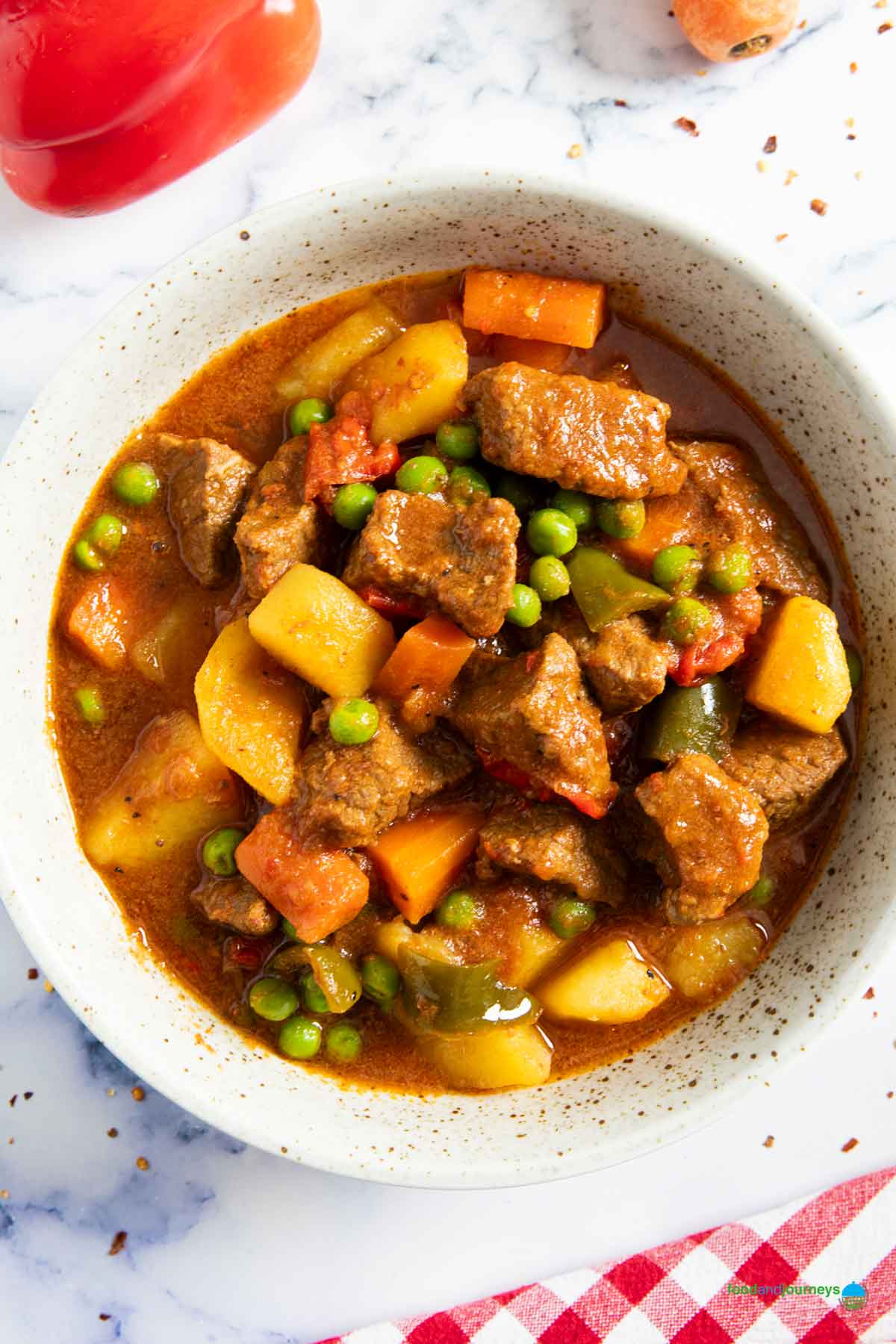
    A plate of Filipino kaldereta with beef, with red pepper and carrot next to it.


    Filipino beef kaldereta is one of those dishes that’s often served for family gatherings, holidays, and special occasions.  

    Nowadays, pork kaldereta is also common.  But growing up in Manila, I remember beef cost more, hence we didn’t get to enjoy it every day — and this dish was the default ‘beef dish’ for special occasions (back then, at least).

    In this authentic beef kaldereta recipe, you will see how locals traditionally build layers of flavor in this stew.  

    There is no required searing of the meat; instead, you start by sautéing garlic and onions, then add the rest of the ingredients in sequence to maximize their flavor.

    Oh! In case you’re wondering, this recipe does not use fish sauce, just regular salt. 🙂

    Jump to:
    • Why kaldereta is a keeper!
    • Ingredients
    • How to make beef kaldereta
    • Helpful tips
    • Recipe variation
    • Storage
    • FAQs
    • Serving suggestions
    • 📖 Recipe

    Why kaldereta is a keeper!

    • Deep, layered flavor. Slow-simmered beef absorbs a rich, tomatoey-liver sauce that’s a bit sweet, tangy, and salty — traditional characteristics of Filipino cuisine.
    • One-pot practicality.  No need for an extra pan to boil or sear the meat, everything cooks in a single pot; less cleanup and more simmering for depth of flavor.
    • Customizable and forgiving.  It’s a beginner-friendly recipe that’s hard to mess up; you can also easily add more spice, vegetables, or crushed tomatoes to boost the sauce’s richness.  It’s all up to you.

    Ingredients

    All the ingredients you need to make Filipino kaldereta with beef at home.

    (See the recipe card below for measurements.)

    • Beef – I generally use beef chuck for stewing, because it’s easily available in all supermarkets here in Stockholm.
    • Olive oil – extra-virgin olive oil if possible.
    • Vegetables – garlic, onion, carrots, potatoes, bell peppers, and green peas (frozen peas are absolutely fine).
    • Stock – I always use beef stock, but chicken stock can also work.
    • Crushed tomatoes – use your favorite brand of canned tomatoes.
    • Liver spread – you would need to go to a Filipino store to get this; it’s not typically available in Chinese, Thai, or Vietnamese stores.
    • Herb & seasoning – bay leaves, salt, ground black pepper, and chili flakes.
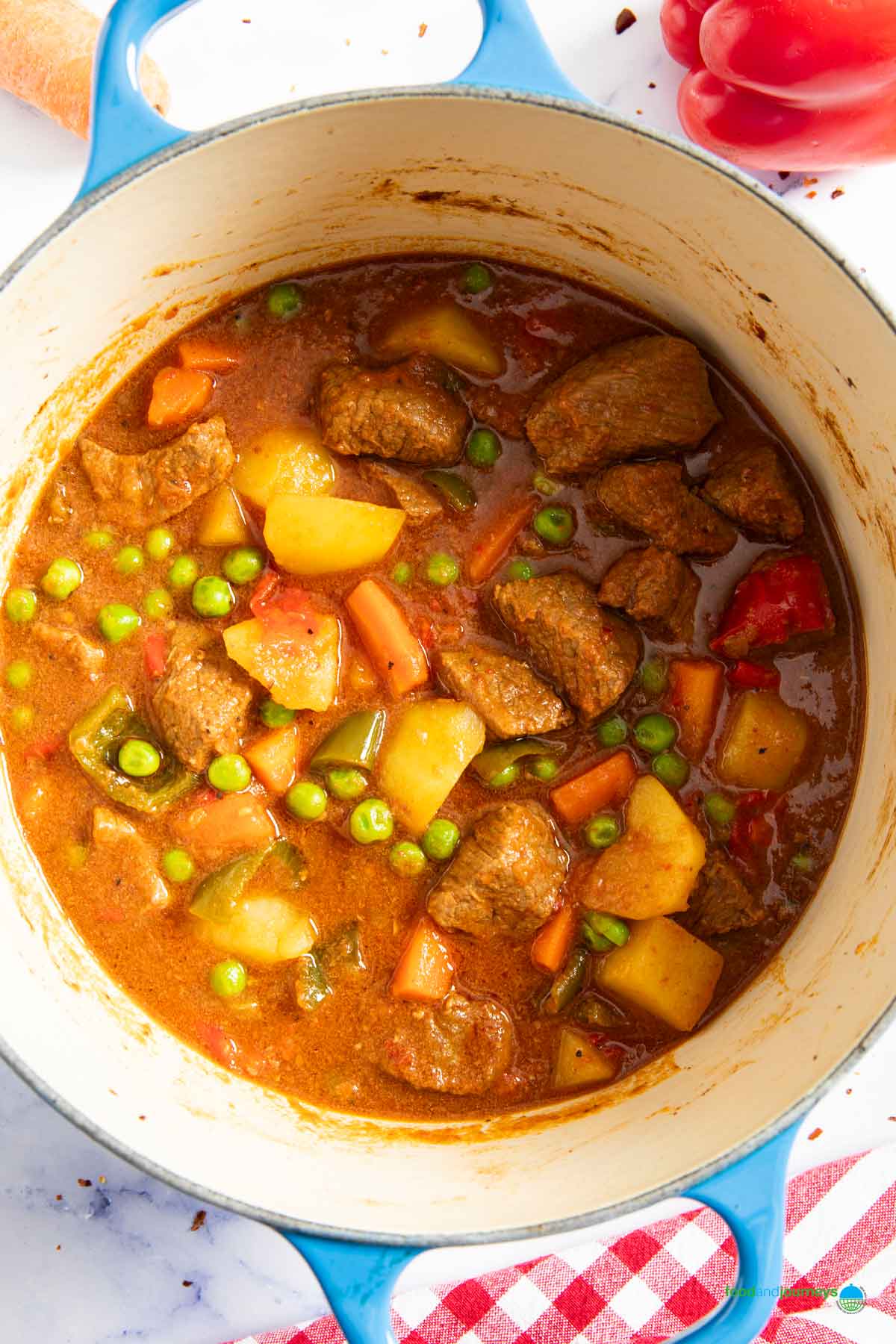
    A one-pot dish of Filipino kaldereta made with beef.

    How to make beef kaldereta

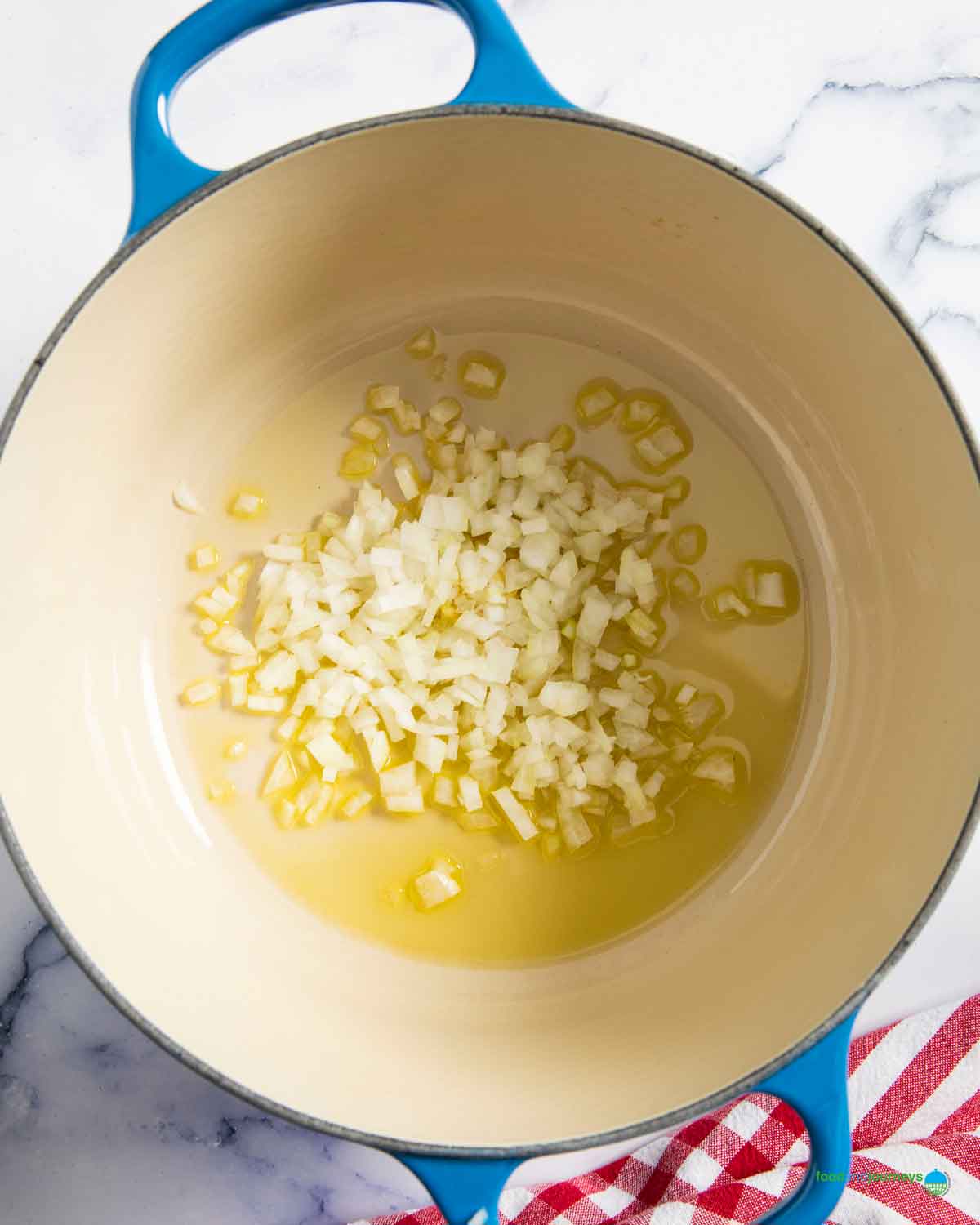
    Sautéing the onion and garlic is the first step in making this traditional, one-pot beef kaldereta at home.

    Start by placing a Dutch oven (or a large saucepan) over medium-high heat.

    Pour in the olive oil, then add the garlic and onion.

    Sauté until they turn soft.
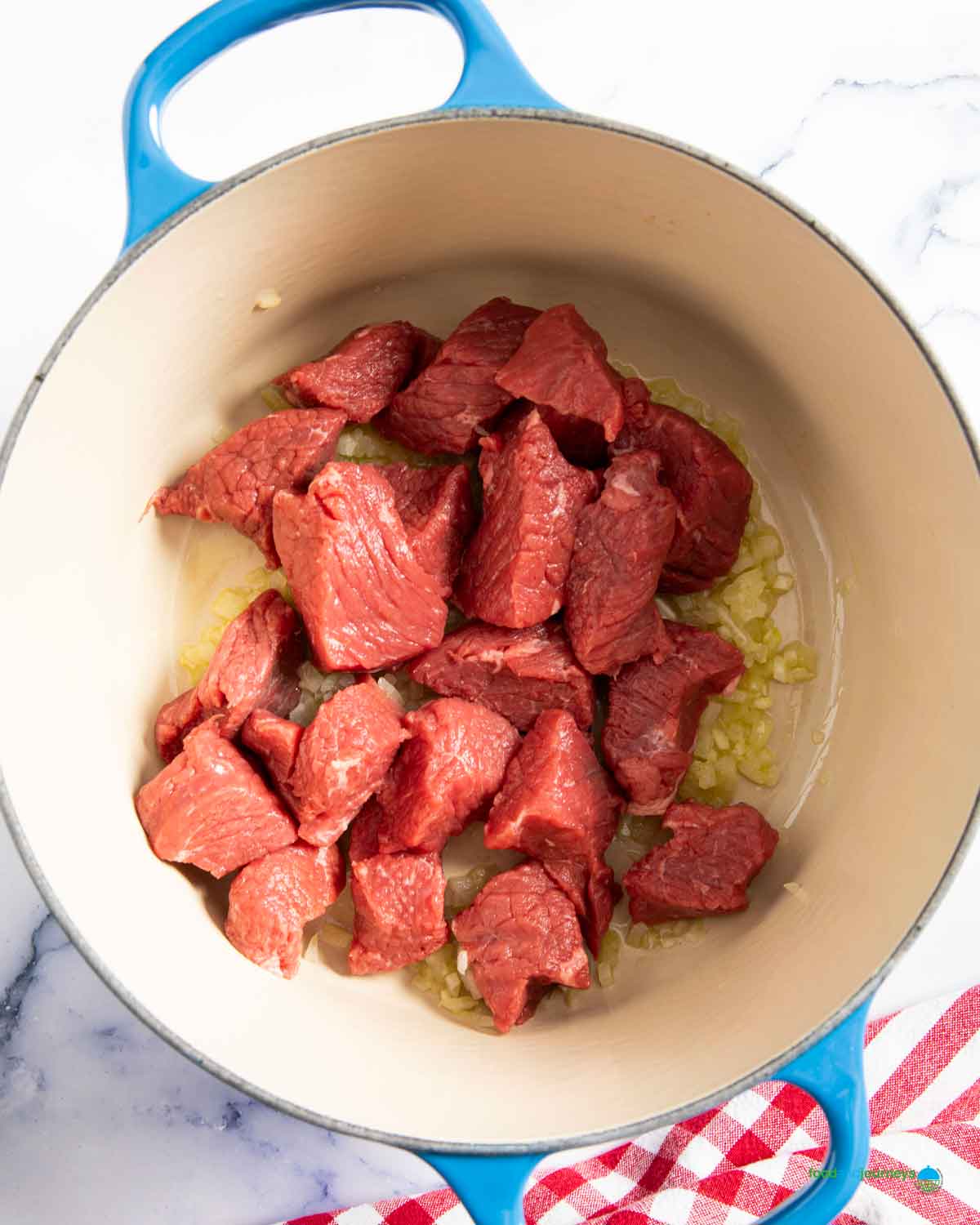
    Adding the chunks of beef into the sautéed onion and garlic, to cook it a bit, before starting with the layering of flavor for the kaldereta sauce.

    Add the pieces of beef.

    Cook until they’re no longer pink — mix regularly.
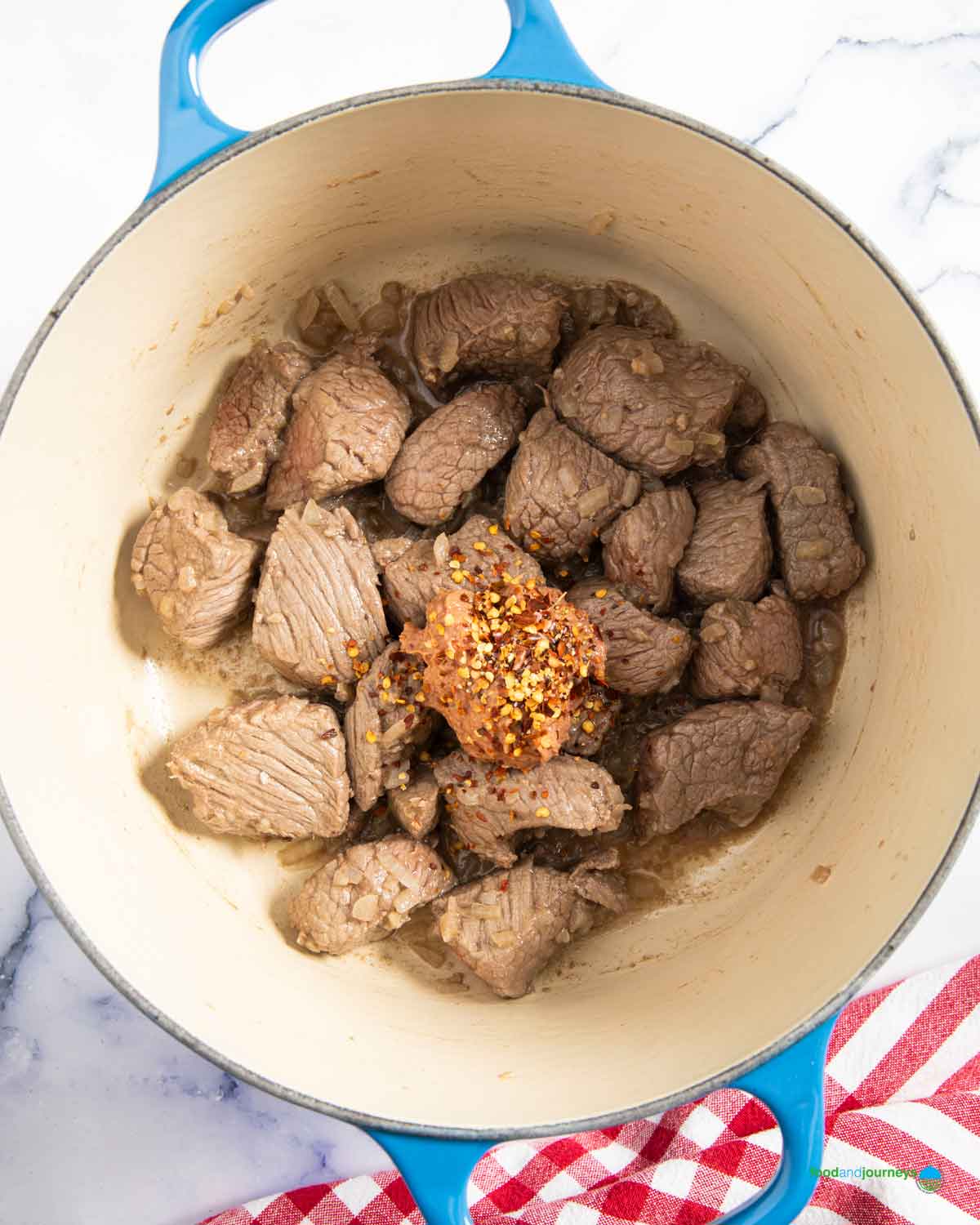
    Adding liver spread with a bit of chili flakes for heat, after browning the beef, gives the kaldereta its unique sauce.

    Add liver spread and chili flakes.

    Mix, coating the beef with liver spread as you go.

    Stock, crushed tomatoes and bay leaves are added to the beef, and letting it simmer to get the thickened kaldereta sauce.

    Pour in the stock, then add the crushed tomatoes and bay leaves.

    Cover and bring to a soft boil.
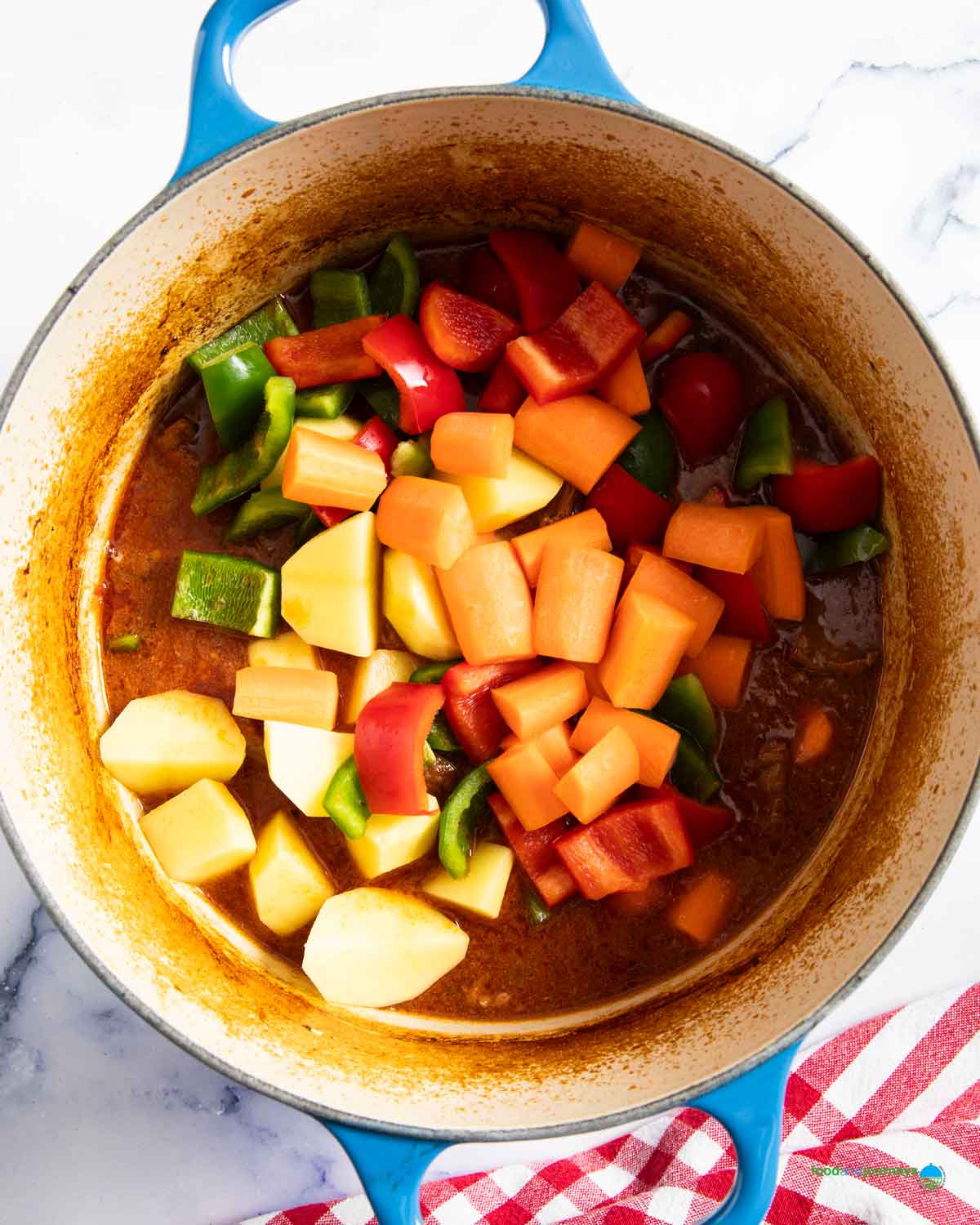
    Chopped carrots, potatoes and bell peppers are added to the pot of kaldereta, once the beef has softened.

    Lower the heat and simmer until the beef becomes tender — typically 1 & ½ to 2 hours.

    Add the chopped potatoes, carrots, and bell peppers.

    Continue simmering until the vegetables are soft.
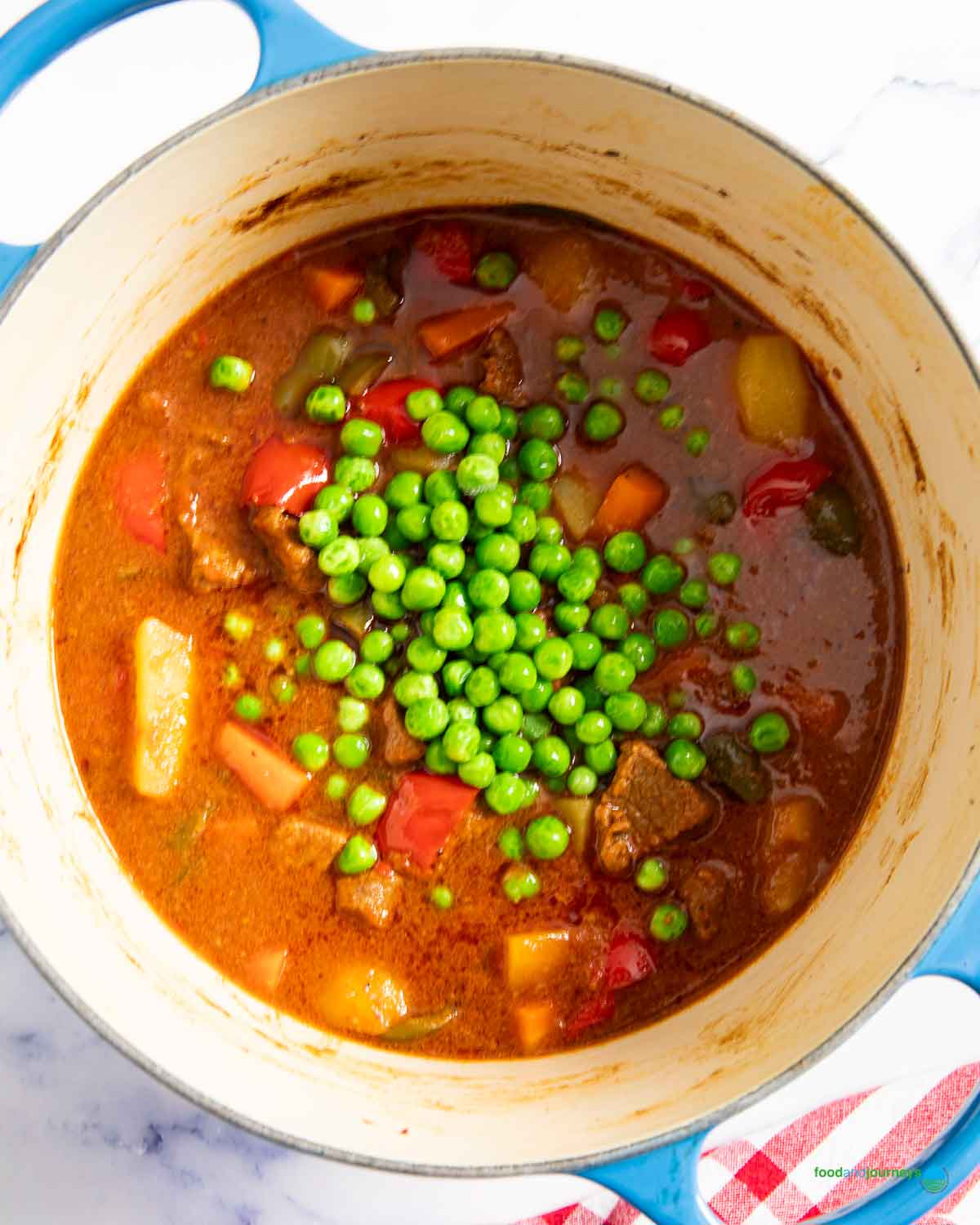
    Adding the green peas in the last part of cooking the Filipino kaldereta with beef.

    Add the green peas and mix.

    Taste and adjust seasoning by adding salt, ground black pepper, and (more) chili flakes.

    Place the lid back, cook for a couple more minutes, then take it off the heat.

    Transfer into plates and serve!

    A plate of kaldereta made with beef, a classic Filipino comfort food.

    Helpful tips

    • Do not add all the liver spread at once, especially if you’re not familiar with it. Start with 2 tablespoons, taste as it simmers, and add more if that’s what you prefer. 
    • Cut the beef into even, identical-sized pieces, so they cook at the same time — this is to avoid ending up with some tough bits, and others falling apart.
    • Remember to balance and adjust seasoning at the end.  As is typical of any stew, the spices and seasoning intensify as the liquid reduces.  So, taste and make adjustments before taking your Filipino beef kaldereta off the heat.

    Recipe variation

    • Searing the beef.  I see some people searing (browning) the beef before sauteing the onions, which is absolutely fine as well.  I prefer to make it the way my mother does.
    • Olives.  Some locals add green olives for a bit of earthiness and a burst of salt that cuts through the richness of the sauce.
    • Cheese.  You can add grated cheddar or quick-melt cheese towards the end—mix it with the rest of the ingredients to get a slightly creamy finish.  Yep, this is quite common nowadays, not when I was growing up, though. 😉

    Storage

    How long does it last in the refrigerator?

    Store it in an airtight container, and Filipino beef kaldereta will last for 3-4 days, tops.

    Can you freeze it?

    Absolutely.  Let it cool completely, transfer it to an airtight container, and place it in the freezer for 2 – 3 months.

    When reheating, it’s better to take your beef kaldereta out of the freezer the night before, refrigerate to thaw, then reheat slowly.
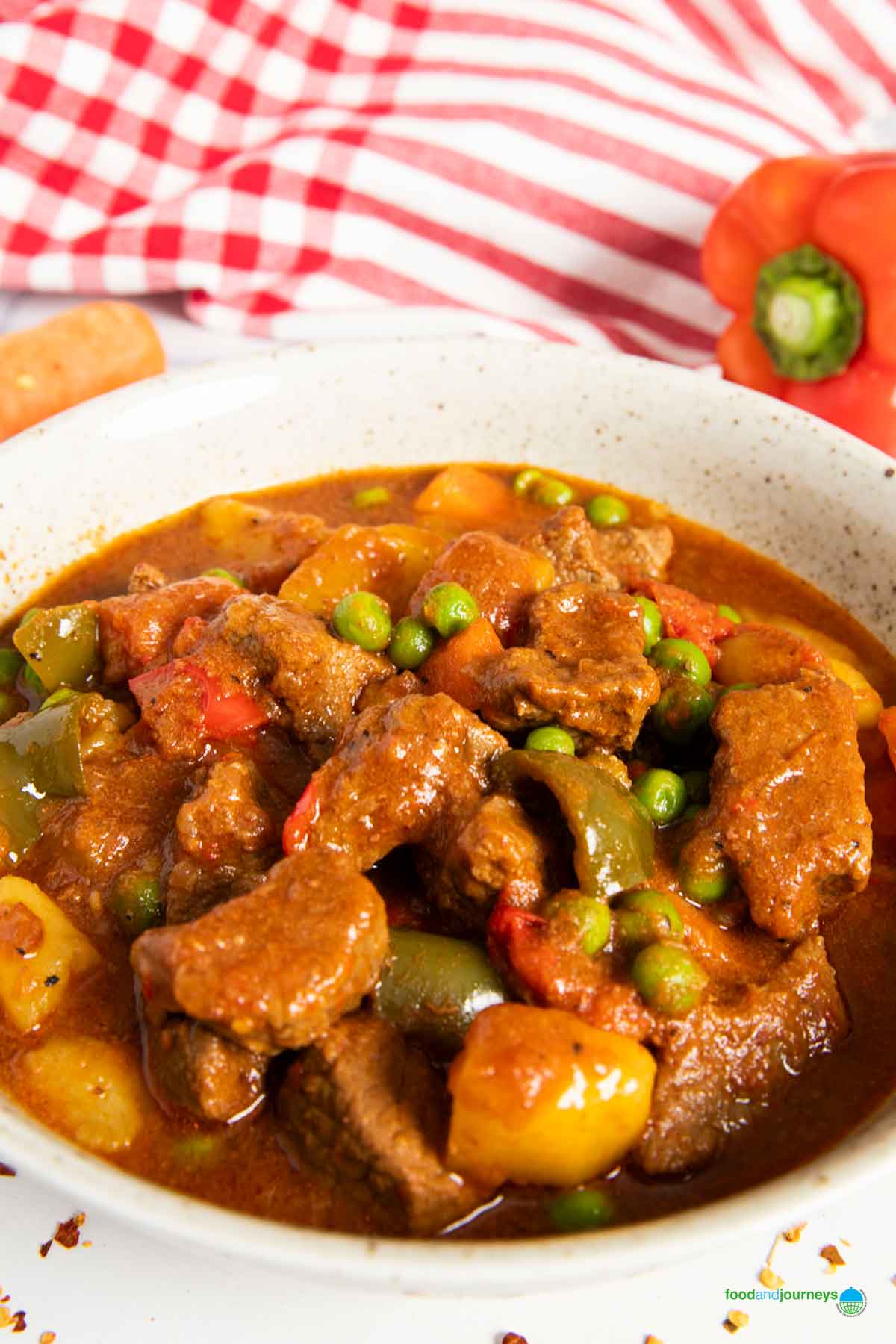
    A closer shot of Filipino kaldereta with beef, highlighting its thick sauce.

    FAQs

    What cut of beef is best for kaldereta?

    Chuck, brisket, or beef shank are the best cuts to use.  These cuts become tender when cooked slowly, creating an intensely flavorful sauce.

    Can you make Filipino beef kaldereta without liver spread?

    Yes, that is more common nowadays as well.  Omitting the liver spread is fine, but note that the sauce will be noticeably lighter—basically, you’re using the crushed tomatoes as the flavor base.

    What is the difference between kaldereta, afritada, and mechado?

    Believe me, I often wonder myself. 😉

    Traditionally, kaldereta is richer because of the liver spread added.  Both afritada and mechade have tomato-based flavor, but the vegetables (or extenders added) differ a bit.

    Serving suggestions

    Beef kaldereta is at its best when served with sides that balance its rich, savory sauce and round out the meal.  From rice and noodles to fresh and creamy accompaniments, these pairings highlight why it remains a staple of Filipino comfort food.

    Explore the serving ideas below and discover more dishes in our collection of classic Filipino recipes.

    A closer shot of freshly cooked lumpiang gulay, ready for serving, with a carrot and scallions on the background.

    Lumpiang Gulay

    The light, crunchy Filipino vegetable spring rolls balance the intensity of the stew, adding freshness and texture to the meal.  

    Served together with steamed rice, this pairing is excellent for family weekend lunches.

    A closer shot of Pancit with canton noodles, highlighting the texture of the noodles and the meat and seafood with it.

    Pancit Canton

    The stir-fried canton noodles soak up just enough kaldereta sauce, creating a hearty, filling combination that’s especially popular for gatherings and celebrations.  

    Served together, they turn a simple meal into a classic Filipino feast.

    A bowl of chicken salad with macaroni, Filipino style, ready for chilling before serving.

    Filipino Chicken Macaroni Salad  

    This creamy chicken macaroni salad brings a cool, slightly sweet contrast to the bold flavors of beef kaldereta.  

    Its soft pasta and mayonnaise-based dressing balance the stew’s rich sauce, ending the meal on a lighter note.  

    This pairing is especially popular for parties and family gatherings, where kaldereta anchors the table and the Filipino-style chicken salad rounds it up nicely.

    Beef kaldereta, indeed, is the kind of dish that brings people to the table, with its bold flavors, tender beef, and deeply satisfying sauce.  Whether you’re cooking it for a weekend family meal or a special gathering, this recipe is well worth trying at home.

    If you enjoyed this kaldereta, be sure to explore more traditional Filipino dishes for everyday meals and celebrations alike!

    GET MORE IDEAS FROM THIS LIST OF DINNER RECIPES FROM AROUND THE WORLD!

    📖 Recipe
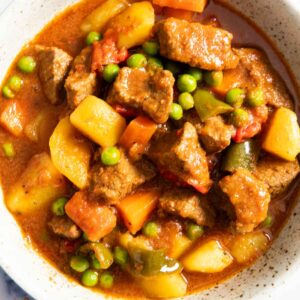
    A closer shot of a plate of beef kaldereta, a traditional Filipino stew.

    Beef Kaldereta Recipe

    Beef kaldereta is a classic Filipino beef stew that’s deliciously rich and surprisingly easy to make at home.  It uses simple ingredients and straightforward steps, making it a great starting point if you’re new to cooking Filipino dishes or slow-simmered stews!
    No ratings yet
    Print Pin Rate
    Course: Main Course
    Cuisine: Filipino
    Prep Time: 20 minutes minutes
    Cook Time: 2 hours hours 30 minutes minutes
    Total Time: 2 hours hours 50 minutes minutes
    Servings: 4
    Calories: 366kcal
    Author: Neriz

    Equipment

    • Chopping Board
    • Kitchen Knife
    • Pyrex Measuring Cups
    • Measuring Spoons
    • Dutch oven (24 cm or 4.2 litres) or
    • Medium to large saucepans (with lid)

    Ingredients

    • 3 tablespoons olive oil
    • 500 grams beef, stew cuts (about 1 pound)
    • 2 cloves garlic, minced or grated
    • 1 small onion, finely chopped
    • 1 to 1 & 1/4 cups stock
    • 3 to 4 tablespoons liver spread
    • 1/2 cup crushed tomatoes
    • 2 medium bell peppers (1 red & 1 green)
    • 2 small carrots, peeled and chopped
    • 2 medium potatoes, peeled and chopped
    • 1/2 cup green peas, frozen
    • 2 pieces bay leaves, dried
    • 1/2 teaspoon chili flakes
    • salt and ground black pepper, to season

    Instructions

    • Pour the olive oil into a Dutch oven (or a large saucepan) and place it over medium-high heat.
    • Add the garlic and onion once the oil is ready, then saute until they soften.
    • Add the beef pieces and cook until no longer pink, stirring regularly.
    • Add liver spread and chili flakes, then mix, coating the beef with the liver spread in the process.
    • Pour in the stock, then add the crushed tomatoes and bay leaves.
    • Cover, bring to a soft boil, then lower the heat and simmer until the beef becomes tender — typically 1 & ½ to 2 hours.
    • Add the chopped potatoes, carrots, and bell peppers, then continue simmering until the vegetables are soft.
    • Add the green peas and mix.
    • Taste and adjust seasoning by adding salt, ground black pepper, and (more) chili flakes.
    • Place the lid back, cook for a couple more minutes, then take it off the heat.
    • Transfer into serving plates and enjoy!

    Notes

    • Cook’s Tip:  Do not add all the liver spread at once, especially if you’re not familiar with it.  Start with 2 tablespoons, taste as it simmers, and add more if that’s what you prefer.
    • Refer to the post for more tips and suggestions.

    Nutrition

    Calories: 366kcal | Carbohydrates: 44g | Protein: 8g | Fat: 19g | Saturated Fat: 4g | Polyunsaturated Fat: 2g | Monounsaturated Fat: 12g | Cholesterol: 23mg | Sodium: 615mg | Potassium: 1123mg | Fiber: 8g | Sugar: 11g | Vitamin A: 12726IU | Vitamin C: 147mg | Calcium: 67mg | Iron: 4mg
    Tried this Recipe? Pin it for Later!Mention @foodandjourneys or tag #foodandjourneys!

    More Main Dish Recipes

    • A pan of Persian eggplant and tomato stew, garnished with fresh parsley.
      Persian Eggplant and Tomato Stew
    • A serving of Filipino chicken afritada, showing the chicken and vegetables in the sauce.
      Chicken Afritada (Filipino Chicken Stew)
    • Freshly baked Spanish stuffed eggplants, golden and perfect in color.
      Spanish Stuffed Eggplants (Berenjenas Rellenas)
    • A plate of traditional Pancit canton, highlighting the shrimp and vegetables.
      Pancit Canton

    Reader Interactions

    Leave a Reply Cancel reply

    Your email address will not be published. Required fields are marked *

    Recipe Rating


    This site uses Akismet to reduce spam. Learn how your comment data is processed.

    Primary Sidebar

    Latest About Me pic, from Torino, September 2025.

    Hej there!

    A smorgasbord of traditional and delicious international recipes awaits you, so feel free to look around and pick your favorites. No need to leave your kitchen to experience the real deal!

    More about me →

    Image for listing as-featured-on

    Winter Favorites!

    • Feature image for Patatas a la Riojana, served with some bread.
      Spanish Chorizo and Potato Stew
    • A serving of kalops, the classic beef stew from Sweden.
      Swedish Beef Stew (Kalops)
    • A serving of rabo de toro, showing how its traditionally served in Malaga, with French fries.
      Spanish Oxtail Stew (Rabo de Toro)
    • Feature image for Turkish Celeriac Soup showing a bowl of it, ready for serving.
      Turkish Celeriac Soup
    • A bowl of Filipino mung bean soup, garnished with chicharon.
      Ginisang Munggo (Filipino Mung Bean Soup)
    • A closer shot of German beef goulash stew, highlighting the intense paprika sauce.
      German Beef Goulash (Rindergulasch)
    • A serving of loubia, highlighting the thickness of the sauce.
      Loubia (Moroccan White Bean Stew)
    • Feature image of Spanish Chorizo and Chickpea Stew, showing a serving of the dish, with slices of bread.
      Spanish Chorizo and Chickpea Stew

    Popular Posts

    • Two servings of German Potato Soup (Kartoffelsuppe). Both creamy potato soup servings are garnished with spring onions.
      German Potato Soup (Kartoffelsuppe)
    • A closer shot of kanelbullar on a cooling rack, highlighting the filling of the buns.
      Swedish Cinnamon Buns (Kanelbullar)
    • A pan of pollo al ajillo, fresh out of the stove, ready for serving.
      Spanish Garlic Chicken (Pollo Al Ajillo)
    • Arroz de Tomate in a pan, ready for transferring to serving plates, with fresh cherry tomatoes next to it.
      Portuguese Tomato Rice (Arroz de Tomate)
    • Latest feature image for drommekage, highlighting the texture of the cake.
      Danish Dream Cake (Drømmekage)
    • Three freshly-baked pasticciotti sprinkled with powdered sugar and served wiith espresso.
      Pasticciotto (Italian Cream Filled Pastry)
    • An image showing two bowls of Finnish Salmon Soup served with some bread.
      Finnish Salmon Soup (Lohikeitto)
    • An overhead shot of a bunch of freshly baked taralli, served with a shot of espresso, with scaterred fennel seeds on the background.
      Taralli (Italian Crackers)
    • Swedish Almond Tart
      Swedish Almond Tart
    • Latest feature image (Apr23) for Filipino picadillo showing the dish on a plate.
      Filipino Picadillo
    • Latest feature image for Salt and Pepper pork belly, showing the slices garnished with more chili.
      Salt and Pepper Pork Belly
    • A slice of cardamom sponge cake, served with a cup of coffee.
      Swedish Cardamom Cake

    Favorite Snacks

    • Fried panzerotti served with a glass of wine, for snack.
      Panzerotti (Panzarotti)
    • A collage of flammkuchen toppings to choose from.
      Classic Flammkuchen (+ More Flammkuchen Toppings!)
    • Freshly cooked panelle from Palermo, served with a dustingg of ground black pepper.
      Panelle (Sicilian Chickpea Fritters)
    • Chocolate balls served with coffee, for afternoon snack.
      Swedish Chocolate Balls (Chokladbollar)

    Popular Cuisines

    • Latest feature image for authentic Swedish recipes, showing västerbottenostpaj, a midsummer favorite.
      Authentic Swedish Recipes
    • Feature image for Italian recipes by region post.
      Italian Recipes by Region
    • Feature image for German Recipes post.
      Authentic German Recipes
    • Feature image for Portuguese Recipes, as part of recipes by country.
      Easy Portuguese Recipes
    • Feature image for Traditional Spanish Recipes, a pan of espinacas con garbanzos.
      Traditional Spanish Recipes
    • Feature image for Finnish Recipes post.
      Easy Finnish Recipes
    • Feature image for Greek Recipes post.
      Traditional Greek Recipes
    • Feature image for Lebanese Recipes post.
      Lebanese Recipes

    Footer

    Policy

    • Privacy Policy

    Contact

    • About Me

    Copyright

    • Notes on Copyright

    A PARTICIPANT IN THE AMAZON ASSOCIATES PROGRAM, AN AFFILIATE ADVERTISING PROGRAM DESIGNED TO PROVIDE A MEANS FOR SITES TO EARN ADVERTISING FEES BY ADVERTISING AND LINKING TO AMAZON.COM.

    Copyright © 2026. FOOD AND JOURNEYS®

    Rate This Recipe

    Your vote:


    A rating is required
    A name is required
    An email is required